If you have spent any time in crypto since 2014, you have almost certainly landed on CryptoCompare — usually while trying to answer a deceptively simple question: “what is this coin actually worth right now?” The London-based platform, founded by Charles Hayter, grew from a hobbyist price aggregator into one of the industry’s reference data providers. Its institutional arm became CCData, an FCA-authorised benchmark administrator, and after the late-2024 acquisition the data business now operates as CoinDesk Data. The consumer-facing site at cryptocompare.com still runs the coin lists, portfolio and forums that millions of retail users grew up with.
This guide exists because most write-ups about CryptoCompare are either press releases in disguise or five-year-old screenshots. We treat the platform the way a security auditor treats a smart contract: assume nothing, verify everything, and write down the failure modes. Every hard number we quote — API rate limits, supported coin counts, app store availability — is taken from the official cryptocompare.com site or its documentation, and we tell you when something is our own measurement instead.
What CryptoCompare actually is — and what it is not
Strip away the branding and CryptoCompare is three different products wearing one T-shirt:
- A retail data portal. The coin list, top lists (including DeFi categories), interactive charts, mining calculators, exchange and wallet reviews, news aggregation and a portfolio tracker. Free, ad-supported, no trading.
- A data API. Historical OHLCV candles, real-time prices, order book snapshots and reference rates — the same feed that once powered half the crypto dashboards on the internet. We break down tiers and limits in our API & pricing guide.
- An institutional benchmark business. The CCIX index family and regulated reference prices used by funds and ETP issuers. Retail users rarely touch this directly, but it is why the retail numbers are taken seriously.
What CryptoCompare is not is an exchange. You cannot deposit money, buy Bitcoin or withdraw anything on cryptocompare.com. It shows you the market; it does not let you touch it. When you are ready to act on a price you have found, you need a trading venue — that hand-off is exactly where most beginner mistakes happen, so we wrote a dedicated guide to comparing crypto exchanges like an auditor rather than like a fan.
The toolbox, tool by tool
Coin list and top lists
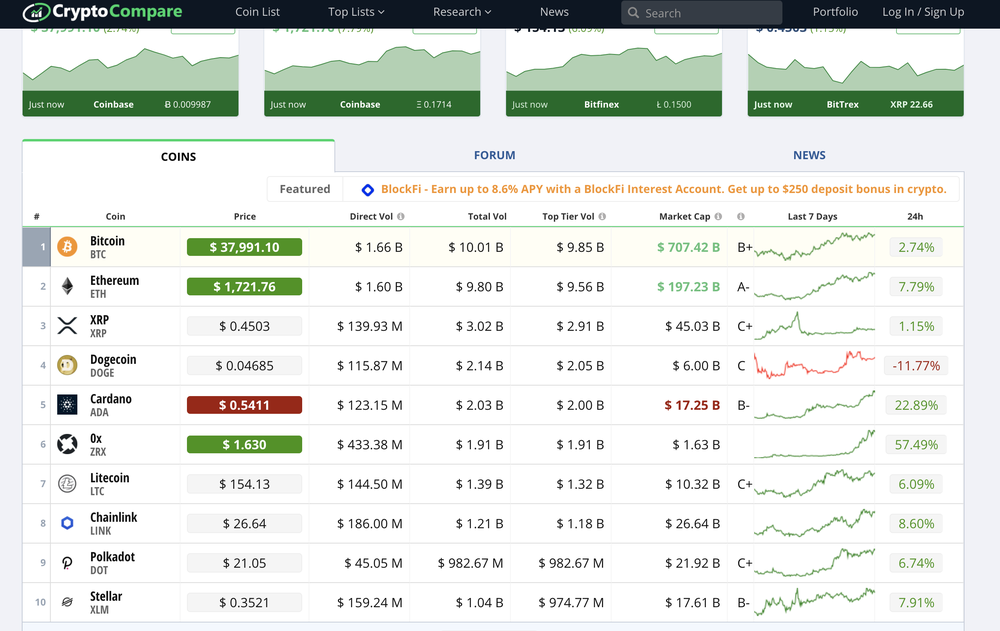
The flagship feature ranks thousands of assets by price, volume and market capitalisation, with a “top tier volume” column that filters out exchanges with dubious reporting — a quiet admission that a large share of headline crypto volume has historically been wash trading. If you only learn one habit from this site, make it this: never judge a coin by its price on a single venue. Cross-exchange aggregation exists because single-exchange numbers lie. Our compare crypto prices guide shows the workflow step by step, with live widgets you can test on this very site.
Portfolio tracker
You add transactions manually — buy, sell, transfer — and the tracker computes cost basis, profit and loss, and portfolio weightings. Because it never connects to your wallet or exchange account, it cannot be drained, phished or subpoenaed for your keys; the trade-off is manual upkeep. In an era of “connect your wallet to see your net worth” apps that silently log every address you own, there is real privacy value in a tracker that knows nothing about you.
Mining calculators
Enter your hash rate, power draw and electricity price; get estimated daily output for Bitcoin, Ethereum Classic, Litecoin, Monero and others. The math is honest, but remember it extrapolates today’s difficulty and price — two variables with the shelf life of warm milk. Treat any mining calculator as a snapshot, not a forecast.
Reviews and news
Hundreds of structured reviews of exchanges, wallets and crypto cards, plus aggregated news from major outlets. The reviews are a genuinely useful starting index, though — as with any site that carries affiliate links, ours included — you should read them as “curated overviews”, not gospel. We keep our own wallet coverage brutally specific in the wallet comparison guide.
Mobile apps and API
The iOS and Android apps mirror the portfolio and price alerts; the API serves everyone from students to ETF issuers. Both get full treatment in our app download guide and API guide.
Custodial vs non-custodial: the sixty-second version
Because CryptoCompare sits exactly at the junction where people move from “watching prices” to “holding coins”, this is the right place for the industry’s most important distinction:
An exchange account is like a bank. Binance, Coinbase, Kraken, CEX.IO — they hold the keys, you hold a claim. Password lost? Support resets it. Exchange collapses (ask anyone who lived through Mt. Gox or FTX)? Your claim joins a bankruptcy queue.
A non-custodial wallet is your personal safe. MetaMask, Trust Wallet, Ledger, Tangem — you hold the keys, nobody else. Lose the seed phrase and there is no support line on Earth that can reset it, because that impossibility is precisely what makes it secure.
The rule of thumb auditors actually follow: keep on an exchange only what you are actively trading; move long-term holdings to self-custody, ideally hardware. Everything else on this site is a footnote to that sentence.
Where CryptoCompare shines — and where it doesn’t
| Area | Strong | Weak |
|---|---|---|
| Price data | Cross-exchange aggregation, top-tier volume filtering, deep history back to 2014 | Free API tier has rate limits that serious bots outgrow quickly |
| Portfolio | Private by design, no wallet connection required | Manual entry only; no DeFi position tracking |
| Reviews | Huge catalogue, structured criteria | Update cadence varies; always check the review date |
| Apps | Solid alerts and watchlists on iOS/Android | Fewer features than the desktop site; no desktop app as such |
| Trust | FCA-authorised benchmark arm; data used by institutions | Consumer site carries ads and sponsored placements — read labels |
The 2026 context: rebrands, MiCA and why data provenance suddenly matters
Three things changed the data landscape since the last time most people read a CryptoCompare review. First, the corporate shuffle: CryptoCompare → CCData → CoinDesk Data (February 2025), under the Bullish group umbrella. The consumer site remains, but serious data licensing now happens under the CoinDesk Data banner. Second, MiCA — the EU’s Markets in Crypto-Assets regulation — came into full force, and with it a wave of exchanges tightening KYC, delisting non-compliant stablecoins and publishing proper reserve attestations. If you are in the Netherlands, Italy, Sweden or anywhere else in the EU, the venue you choose now matters legally, not just financially; our KYC comparison explains what verification actually checks in 2026. Third, benchmark-grade pricing became a compliance requirement rather than a luxury: an ETP issuer cannot mark its books to “whatever CoinMarketCap showed at lunch”. That is why FCA-authorised reference rates — the thing CryptoCompare’s institutional arm pioneered — are now the quiet plumbing behind a surprising share of regulated crypto products.
How to actually use price aggregators without getting burned
- Compare the aggregate, trade the venue. Use CryptoCompare (or our live widgets) to find the fair cross-market price, then check the specific price and depth on the exchange where you will execute. The spread between those two numbers is your real cost.
- Watch volume quality, not volume quantity. A coin doing $50M on one obscure exchange and $2M everywhere else is a red flag with a ticker symbol.
- Convert with a calculator before you commit. Fees and network costs turn “roughly £500 of ETH” into surprisingly not-£500. Our crypto calculator does live conversion in your browser.
- Plan the exit before the entry. How do you get money out — to your bank, in your currency, at what fee? Most people research this the day they need it, which is the worst possible day. Read the off-ramp comparison first.
- Graduate to self-custody on a schedule. Decide in advance the amount above which coins move to a hardware wallet. Write it down. The wallet guide covers the honest trade-offs.
A brief history, for context
CryptoCompare launched in 2014, when “crypto data” meant refreshing a Bitcointalk thread and hoping. It earned its reputation the slow way: publishing exchange reviews when nobody else bothered, building one of the first serious cross-exchange aggregation methodologies, and — crucially — releasing monthly Exchange Benchmark reports that graded venues on security, regulation and data integrity long before “proof of reserves” became a hashtag. The forum-era community features have aged, and parts of the review catalogue update slower than the market moves; we say so plainly because pretending otherwise would make this guide worthless. But the core aggregation engine and the benchmark methodology remain reference-grade, which is why institutions kept buying the data even as the consumer crypto media landscape burned down and rebuilt itself twice. If you want the full corporate paper trail — founding, FCA authorisation, the CCData years, the CoinDesk acquisition — the official site and its press pages document each step; we summarise, they own the record.
Who this site is for
Three kinds of readers get the most out of these guides. The price-checker who wants live numbers and a market-cap sanity check without opening five tabs — start with live prices and market cap. The builder evaluating data feeds for an app or a thesis project — go straight to the API guide. And the careful beginner who has heard enough horror stories to want the boring, verifiable version of every claim — read the custodial/non-custodial section above twice, then the wallet and KYC guides. If you remember nothing else: data sites show you the market, exchanges let you touch it, wallets let you own it. Confusing those three roles is where every expensive crypto mistake begins.
Frequently asked questions
Is cryptocompare.uk the official CryptoCompare website?
No. This is an independent, unaffiliated guide. The official consumer site is cryptocompare.com, and the institutional data business now operates as CoinDesk Data. We source factual product claims from the official site and clearly mark our own opinions.
Is CryptoCompare free to use?
The consumer website — coin lists, charts, portfolio, reviews, news — is free and ad-supported. The data API has a free tier with rate limits and paid commercial tiers; see our API & pricing guide for the 2026 breakdown.
Can I buy Bitcoin on CryptoCompare?
No. CryptoCompare is a data and comparison platform, not an exchange. To buy or sell you need a trading venue with fiat support. Compare venues on fees, regulation and withdrawal options before depositing anything.
Is the CryptoCompare portfolio tracker safe?
It is one of the safer designs precisely because it is manual: it never connects to your wallet or exchange API keys, so a breach of the tracker cannot move your funds. The trade-off is that you maintain entries yourself.
What happened to CryptoCompare — is it now CoinDesk Data?
The institutional data arm rebranded from CCData to CoinDesk Data in February 2025 after being acquired alongside CoinDesk. The retail site cryptocompare.com continues to operate. FCA authorisation of the benchmark administration business carried through the rebrand.
Where do the live prices on this site come from?
From the public CoinGecko API, fetched directly by your browser — we chose an independent source deliberately, so you can cross-check numbers against CryptoCompare rather than seeing the same feed twice. Prices are indicative, not execution quotes.